

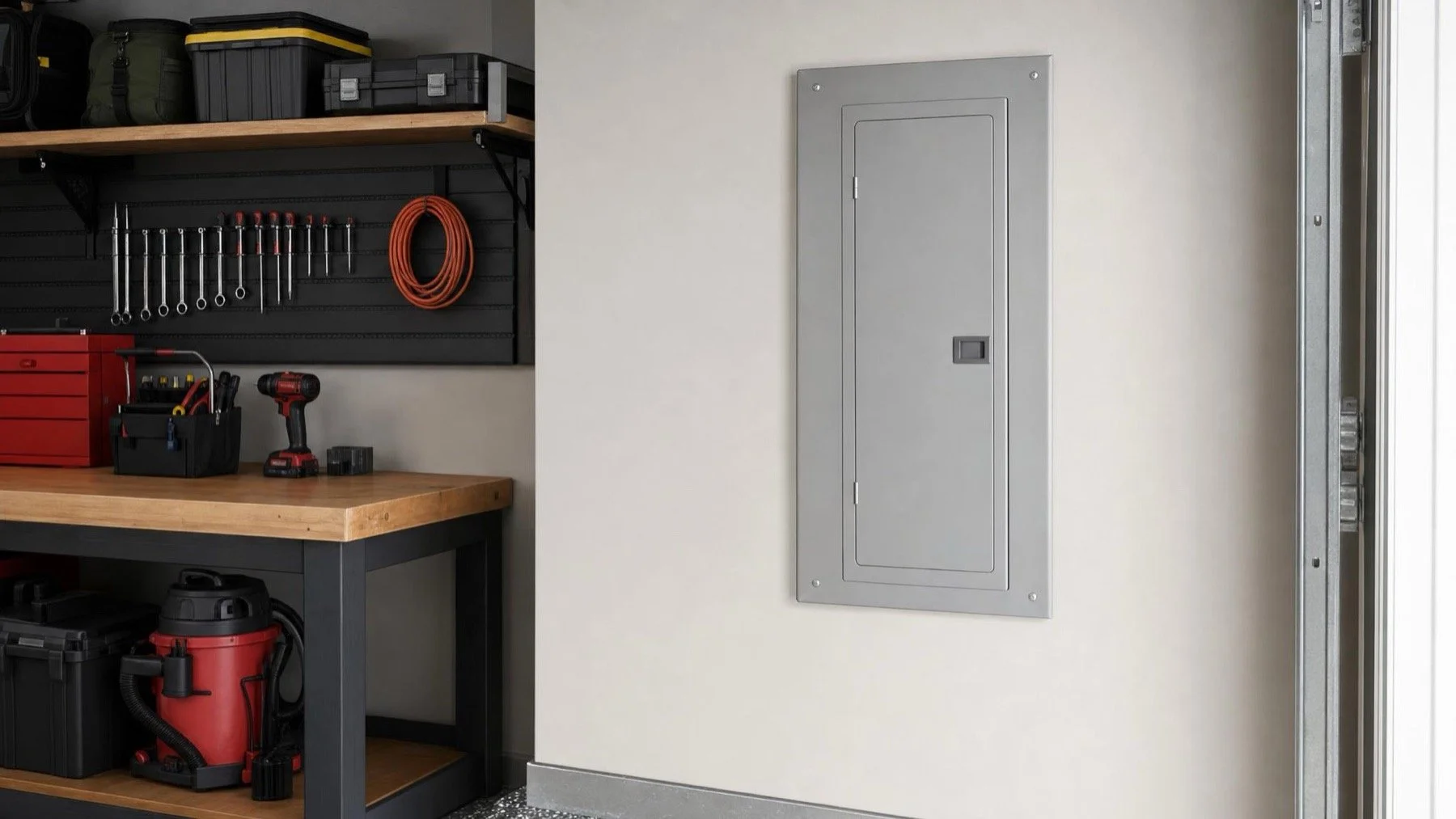
A second panel solves a space and distance problem. Whether your home has enough power for the new loads is a separate question.
You are finishing the basement, building out the garage or adding a rear addition, and your main panel has no empty spaces left. Someone suggests a sub panel. It can be exactly the right answer, but it fixes one specific problem: it gives you more breaker spaces, closer to where the new circuits are needed. It does not give your house more power.
This guide explains when a second panel makes sense, when the real issue is capacity, and how we decide between the two. We plan these panels for homeowners across Toronto and the GTA. The difference matters, because the wrong choice can mean paying for a panel that still leaves breakers tripping.
Space and capacity are different problems
Your main panel is limited by two things. One is physical: the number of spaces for breakers. The other is electrical: the size of the service from the utility, such as 100 or 200 amps. A full panel on a generous service has a space problem. A panel with spaces left on a small service that already runs a heat pump, an EV charger and an electric range may have a capacity problem.
A second panel fed from the main one helps with the first problem. It takes one larger breaker in the main panel and turns it into several new circuit spaces wherever you need them. It does nothing for the second problem, because every amp it supplies still comes through the main service. Our guide to how an electrician calculates household load explains how that capacity question gets answered.
Where a second panel earns its place
- Garages and workshops, attached or detached, with heaters, tools or a charger, where running many separate circuits from the basement would be long and costly.
- Additions and large renovations far from the main panel, where one feed and a local panel keep circuits short.
- Basement suites, where a separate panel can make circuits easier to identify, depending on how the suite is set up. Our basement apartment planning guide covers what else to decide.
- Full main panels on an adequate service, where the alternative is replacing the main panel just to gain spaces.
EV chargers deserve a special mention. A charger is a large load that runs for hours, so it is often what tips a home from a space problem into a capacity problem. Our article on whether you need a panel upgrade for an EV charger walks through that decision.
When the answer is a service upgrade instead
If the load calculation shows the house is near its limit, a second panel only moves the problem. The fix is a larger service and usually a new main panel. When a load calculation shows the home needs more power, we handle upgrades to 100A, 200A or higher capacity. Our electrical panel upgrade service in Toronto covers that work, including coordination with the utility.
Plan the feed and the inspection before drywall
The feed between the panels has to be sized for the breaker that protects it, the new panel needs clear working space in front of it, and the grounding and bonding arrangement in a secondary panel differs from the main one. Those details are easy to get wrong and hard to fix once the walls are finished.
Do not let drywall go up before the required electrical inspection. ESA guidance describes the rough in inspection as taking place when branch circuit wiring and outlet boxes are installed and before any wiring is concealed. Our article on the electrical rough in inspection explains what to expect on the day.
Under ESA guidance, anyone you hire to install a new panel in your home must, by law, be a Licensed Electrical Contractor. A homeowner may do electrical work in a home they own and live in, but ESA guidance requires filing a notification of work, and for panel work we recommend professional installation. If your existing panel is acting up, our troubleshooting work covers main panels, subpanels, breakers and fuses.
Electrical questions homeowners ask
What is the difference between a breaker panel and a sub panel?
The main breaker panel receives power from the utility and contains the main disconnect for the house. A secondary panel is fed from a breaker in the main panel and spreads that power to more circuits in another location.
Can I use a 200 amp panel as a subpanel?
A panel rated for 200 amps can often serve as a secondary panel, as long as it is fed and protected by a correctly sized breaker and wire and is set up for that role. The panel rating is a maximum, and the feeder breaker sets what it can actually supply.
Safety first next step for a full panel
List what you plan to add, from garage heaters to a charger or a suite kitchen, and take a clear photo of your panel with the door open and the labels visible. With that, we can tell you whether you need more spaces, more power or both, and plan the work around your renovation schedule.
Book a KoljiBros assessment
We run the load numbers, check your panel and recommend a second panel or a service upgrade, whichever your home actually needs.
Kolji Bros. Electrical is a Licensed Electrical Contractor, ECRA/ESA #7015453.