

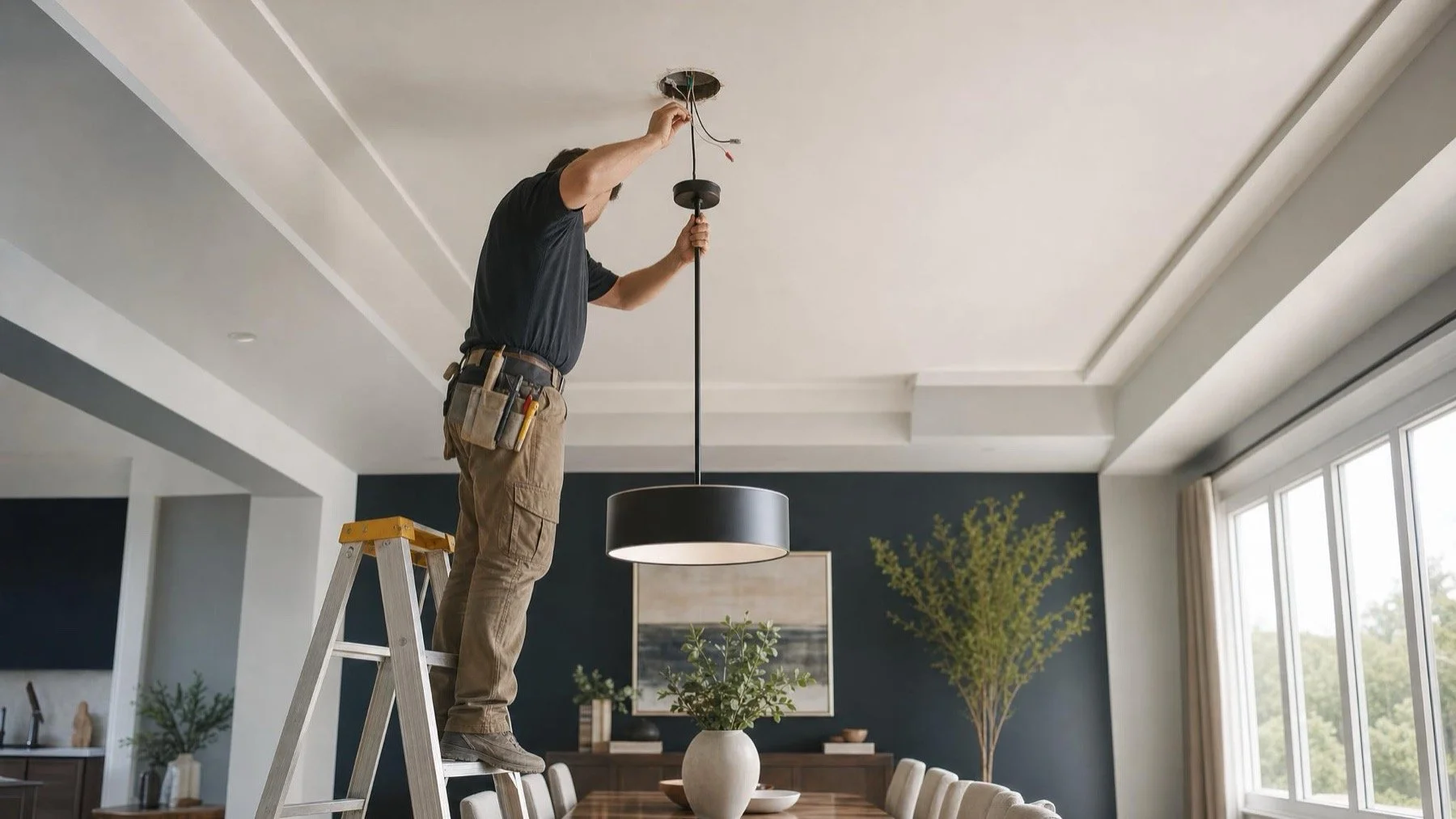
Most problems with a new light have nothing to do with the fixture itself. They start with the box in the ceiling and the wires behind it.
You have picked the pendant for the dining room or the flush mount for the hallway. Light fixture installation looks like a one hour job, and sometimes it is. What decides that is not the fixture. It is the electrical box in the ceiling, how the fixture will be supported, what kind of wiring is behind it and whether the switch or dimmer suits the new light.
We install fixtures for homeowners across Toronto and the GTA. Here is what we check before a new light goes up, so you can choose the right fixture, avoid a second trip to the store and know when the job is bigger than a swap.
The box decides what you can hang
Every ceiling light hangs from an electrical box. A standard box suits a light flush mount. A heavy chandelier, a large glass pendant or a ceiling fan needs a box and support rated for that load, usually fastened to framing or a brace between joists. In older homes it is common to find shallow boxes, boxes held only by plaster, or no box at all, with the old fixture screwed straight to the ceiling.
That is why we look at the weight listed on the fixture box or manual first. Our lighting page describes pendant and chandelier work as proper mounting, support and electrical connections for any weight fixture. If the existing box cannot carry the new light, the fix is to replace or brace the box while the ceiling is open, not to hope the screws hold. Fans add movement as well as weight, which is why we treat them separately in our ceiling fan installation work and in our article on repairing or replacing a ceiling fan.
Old wiring changes the job
Take down an old fixture in a house built in the first half of the last century and you may find cloth covered wires, brittle insulation that cracks when bent, or no ground wire. Years of heat from incandescent bulbs often leave the insulation at the fixture in worse shape than the cable a short distance away. Those wires need careful handling, and sometimes a short repair back to sound cable before a new fixture goes up.
If the attic or basement shows ceramic knobs and tubes, mention it when you book. Knob and tube circuits change what can safely be connected, and it is better to plan for that than to discover it with the ladder already set up.
Dimmers, LEDs and the switch you already have
Many flicker and buzz complaints after a new install come from an older dimmer designed for incandescent bulbs. LED fixtures need a dimmer rated for LED loads, and some fixtures list the dimmers they were tested with. Smart switches add another layer, since many need a neutral wire in the switch box, which some older switch boxes do not have. Check the fixture packaging for the word dimmable and the compatible dimmer list before you buy.
New light where there was none
Replacing a fixture on an existing box is one job. Adding a light where there was none means running new cable, adding a box and often a new switch. ESA guidance notes that adding new lighting can require an electrical notification. ESA guidance warns against hiring unlicensed help even for work that seems as simple as installing pot lights. Homeowners can do their own electrical work in a home they own and live in, but ESA guidance requires a notification of work with ESA.
For recessed layouts, our guide to pot light placement covers spacing and switching. Our lighting installation service in Toronto covers pendants, chandeliers, flush mounts, under cabinet lights and dimmers.
Electrical questions homeowners ask
Do you need an electrician to install a light fixture?
Homeowners in Ontario can generally do their own electrical work in a home they own and live in, with a notification of work filed with ESA. If you hire someone, it must be a Licensed Electrical Contractor, and heavy fixtures, old wiring or new locations are good reasons to hire.
Can you install a light fixture where there isn’t one already?
A new light can usually be added where there was none by running cable from a nearby circuit, installing a rated box and adding a switch. The work typically needs a notification of work with ESA, and access through the ceiling or attic affects how much patching follows.
Safety first next step before you buy the fixture
Check the weight and dimmer requirements on the fixture you like, take a photo of the existing box with the canopy lowered, and note whether the light is on a dimmer. Send those details when you book, and we can tell you whether the job is a straight swap or needs a new box, support or wiring.
Book a KoljiBros assessment
Tell us about the fixture and the room, and we will check the box, support, wiring and dimmer so the new light goes up once and stays put.
Kolji Bros. Electrical is a Licensed Electrical Contractor, ECRA/ESA #7015453.