

Ceiling Fan Repair or Replacement: How to Decide
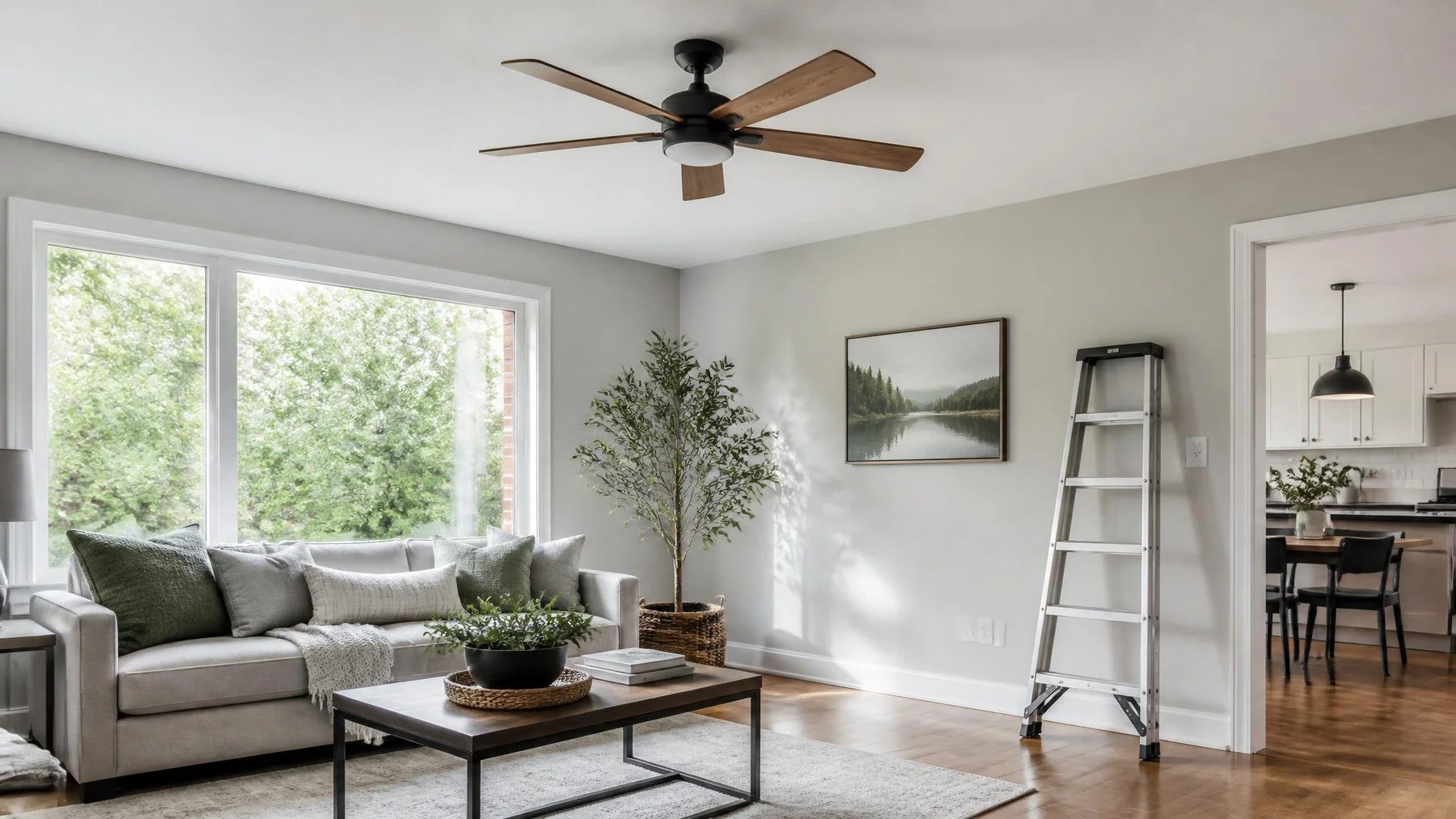
The box hidden above the canopy carries the fan's weight and vibration, so it shapes the repair or replace decision as much as the motor does.
Your ceiling fan has started to wobble, hum, or ignore the remote, and you are deciding whether to have it repaired or buy a new one. The fan's age matters less than you might expect. What decides it is whether the fan itself is sound, whether the box above it is made to carry a moving fan, and whether the controls suit the motor.
We repair, balance, and replace ceiling fans and install boxes rated for fan support for homeowners across Toronto and the GTA. The same symptom can point to a small fix or to a worn out fan, so it helps to know which one you have before you spend money.
This guide covers the checks you can safely make from the floor, the faults worth repairing, the signs that point to replacement, and the work that belongs with a licensed electrician.
Start With What You Can Safely Check
You can learn a lot about a struggling fan without opening anything. Write down what you notice and take a short video of the fan at each speed.
Also note whether the fan runs from a dimmer or a speed control that did not come with it. With the fan off, look for a blade that sits lower than the others, looks bowed, or is chipped. Then find the model number on the box, manual, or receipt, and look for a recognized certification mark.
Stop there. Do not remove the canopy, open the ceiling box, or touch the wiring. Do not bend a blade arm to level a blade either. The same manual warns against bending the blade arms or brackets while balancing or cleaning. Our electrical troubleshooting service picks up where your observations end.
Faults That Are Usually Worth Repairing
Repair is the better choice when the motor is healthy and the problem sits in a part you can name.
A Wobble From Loose Parts or Uneven Blades
Hunter Fan's guide to fixing a wobbly ceiling fan says wobbling can come from warped blades, loose screws, or faulty installation. The Canadian fan manual we reviewed notes that natural wood blades vary in density, so a fan can wobble even when its blades were weight matched. A balancing kit, with a clip to find the light side and small adhesive weights, handles most of these cases.
If the parts are tight and the blades are balanced but the wobble returns, look higher, at the mounting.
Controls That Do Not Suit the Motor
A steady hum or a fan that will not change speed often traces back to the control. Hunter Fan's ceiling fan troubleshooting guide lists an incompatible dimmer switch as a cause of humming, and explains that a failing capacitor can affect your ability to change speed. The Canadian manual says some fan motors are sensitive to solid state variable speed controls and tells owners not to use one.
The fix is a wall control the fan maker approves, or a new capacitor or remote receiver where the part is available. Both keep a good motor in service. Our ceiling fan service includes wall switch and remote setup and smart fan installation.
Noise and a Light Kit That Will Not Work
The Canadian manual says most noises from a new fan disappear after a break in period of about 24 hours. Later rattles usually come from loose housing screws, blade brackets, or a glass shade, and the manual suggests making sure bulbs are tight and not touching the glass. If a correct bulb still will not light, the fault is in the socket, switch, or a connection, and that check belongs with an electrician.
When Replacement Is the Better Choice
Hunter Fan states that in true cases of motor failure, the fan will most often need to be replaced. A motor that grinds or stalls at every speed after the controls have been checked falls into this group.
Damaged blades come next. Hunter Fan notes that warped blades cannot be balanced, although replacement blades may be available depending on the fan. A cracked housing or broken mounting bracket points the same way.
Product safety matters too. In July 2020, Health Canada announced a recall of River of Goods ceiling fans for an injury hazard due to the lack of a secondary support cable, and told owners to stop using them immediately. If your model has been recalled, follow the recall instructions rather than arranging a repair.
The Electrical Safety Authority says electrical products used or sold in Ontario must be approved by an accredited certification or evaluation agency and carry its mark. ESA's page on recognized certification marks lists them. Replace a fan without one with a certified product.
| Symptom | Often worth repairing when | Replacement is likely when |
|---|---|---|
| Wobble | Screws are loose or blades need balancing | Blades are warped and no replacements are sold |
| Humming or no speed change | The control does not suit the motor or a capacitor is worn | The motor itself has failed |
| Fan will not start | A breaker, wall control, or remote is the cause | The motor stays dead after the supply is confirmed |
| Visible damage | A blade or small part can be replaced | The housing or bracket is cracked, or the model is recalled or uncertified |
Check the Box Before You Decide
The part homeowners never see often matters most. A fan hangs from a box fastened to the ceiling structure, and that box carries the fan's weight and the vibration of the blades. The installation manual for a ceiling fan sold at Canadian Tire says to mount the fan to an outlet box marked acceptable for fan support. It warns that most outlet boxes commonly used for light fixtures are not acceptable for fan support and may need to be replaced. It calls for a box and support that can reliably hold at least 35 lb (15.9 kg), and strongly recommends a qualified licensed electrician for installation.
So a fan hung where a light fixture used to be deserves a closer look. If the box was never rated for a fan, or has worked loose from the framing, balancing will not hold the fan steady for long. A heavier replacement fan may also need a different box or support.
Whether you repair or replace, ask your electrician to confirm the box and its support before the canopy goes back up.
Signs to Stop Using the Fan and Call
Switch the fan off at its wall control, keep people from standing under it, and leave it off until it has been checked if you notice any of these:
- A burning smell, or scorch marks on the canopy or ceiling.
- Sparks, crackling, or buzzing from the canopy or wall control.
- The fan drops, tilts, or the canopy pulls away from the ceiling.
- A wobble that worsens quickly, or grinding from the motor.
- The breaker trips when the fan or its light is switched on.
Hunter Fan also recommends a certified electrician when there are burn marks, loose wiring, or no power at the switch.
Who Should Do the Repair or Replacement
ESA states that in Ontario, if you hire someone to do electrical work in your home, by law it must be a Licensed Electrical Contractor. Homeowners have the option to do electrical work in their own home, but they must file a notification of work with ESA. A ceiling fan involves the box, the ceiling structure, the controls, and the wiring, so professional work is recommended.
A Licensed Electrical Contractor files the notification for you. ESA's guide to hiring a licensed electrical contractor explains how to check a 7 digit ECRA/ESA licence number, and lists red flags such as a contractor who asks you to get the permit yourself or offers a discount for cash. Fan work fits alongside our other residential electrical services, so lighting and switch questions can be handled on the same visit.
What Shapes the Cost in Toronto
In Toronto, ceiling fan repair or replacement costs depend on whether the box must be replaced with one rated for fan support, ceiling height and type (older plaster ceilings take more care), the control you choose, the new fan if you are replacing it, and whether new wiring or a switch is needed. Contact Kolji Bros. Electrical for an assessment and a written quote.
Electrical questions homeowners ask
How to repair a ceiling fan?
A ceiling fan repair starts with the checks you can make from the floor and ends with a licensed electrician for anything above the canopy.
Confirm the wall control is on, the breaker has not tripped, and the remote has fresh batteries, then note when the symptom appears. Loose parts and uneven blades can often be fixed, and a control that does not suit the motor can be swapped for one the fan maker approves. The box, the wiring, and a worn capacitor or receiver belong with a Licensed Electrical Contractor, who also files the ESA notification.
The Bottom Line on Ceiling Fan Repair
Repair a ceiling fan when the motor is healthy and the fault is clear: loose parts, uneven blades, a mismatched control, or a worn capacitor. Replace it when the motor has failed, the blades or housing are damaged, or the model is recalled or uncertified. Either way, confirm the box is rated for fan support and leave anything above the canopy to a licensed electrician.
Not sure whether to repair or replace your ceiling fan?
Kolji Bros. Electrical checks the fan, the controls, and the box above it, then explains the repair or replacement in plain language before any work begins. We serve homeowners across Toronto and the GTA.
Kolji Bros. Electrical is a Licensed Electrical Contractor, ECRA/ESA #7015453.