

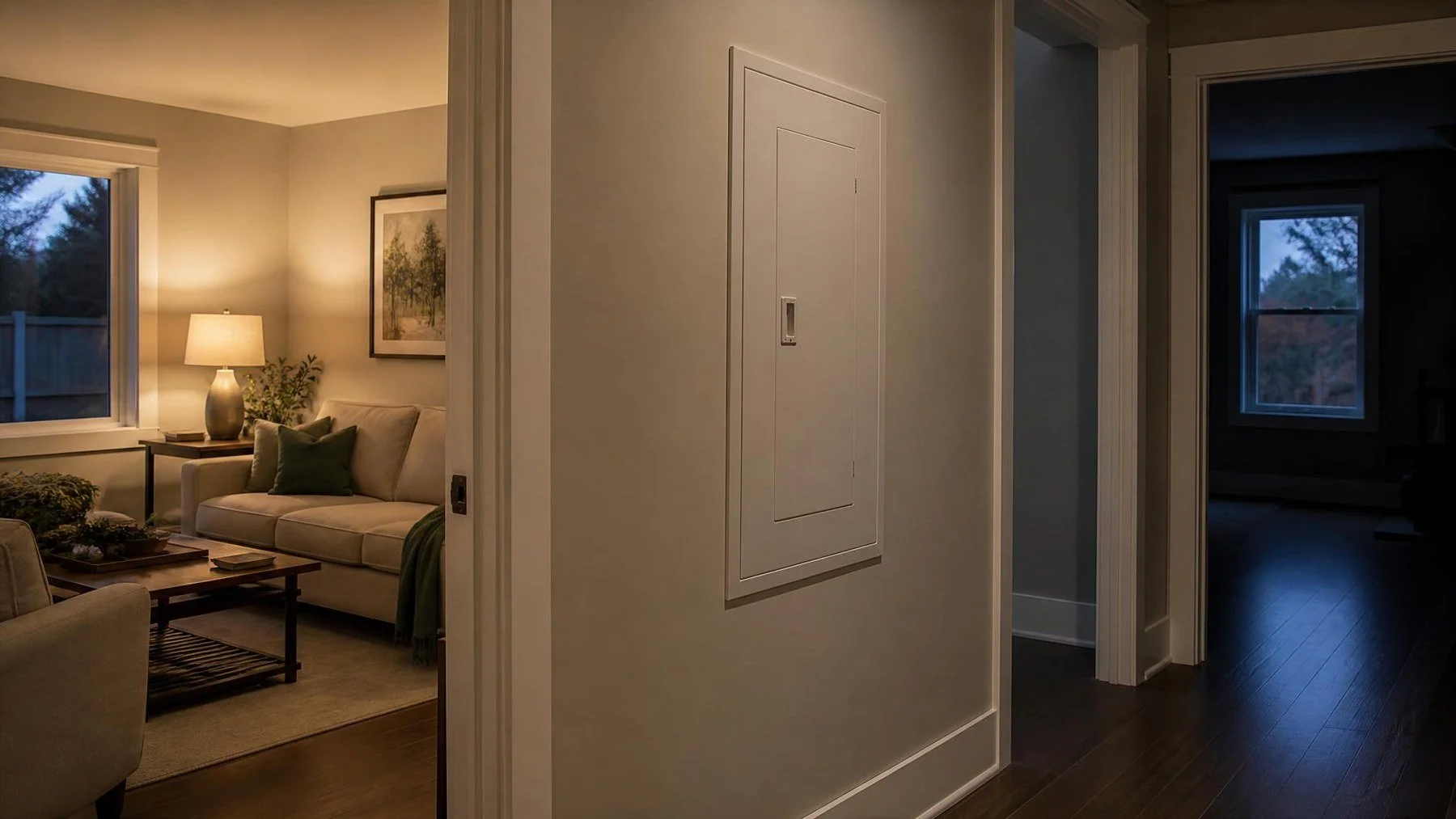
When some rooms go dark and others stay on, the first question is whether the problem sits inside your home or on the utility side. A few safe checks usually answer it.
The kitchen lights work, but the living room is dark. The fridge is humming, yet the bedroom outlets are dead and the dryer will not start. A partial power outage in your house is confusing because it does not look like a normal blackout, and it is tempting to keep flipping switches until something comes back.
A partial outage can come from a tripped breaker, a fault somewhere in your home's wiring, or a problem with the supply coming in from the street. Some of those are a quick reset. Others need a licensed electrician or the utility, and repeated resetting can make them worse. This guide walks Toronto and GTA homeowners through the checks you can do safely, the signs that mean you should stop, and how to decide whether to call Toronto Hydro, an electrician, or both. When we take one of these calls, we start by testing the affected circuits rather than guessing.
Start Outside: Is It Your House or the Street?
Before you go near the panel, find out whether the problem is yours alone. Look out the window. Are the streetlights on? Do the houses next door have lights in the windows? If you share a wall in a semi or a townhouse, a quick text to the neighbour helps. These are the same questions Toronto Hydro asks on its online outage report form, which also links to the utility's live outage map.
If everyone on your street is without power, Toronto Hydro's guidance on what to do during an outage says to report it online or by calling 416‑542‑8000. Outside Toronto Hydro's area, use your own local utility's outage map and reporting line. In a wider outage there is nothing for you to reset at home. Unplug sensitive electronics to protect them when the power returns, and keep the fridge and freezer closed. Toronto Hydro notes that a full freezer keeps food frozen for up to 48 hours if you leave it closed.
If the neighbours have power and only part of your home is out, the cause is more likely inside your house. Toronto Hydro says this directly: if only part of your home is without power, you might have an internal electrical issue. Its report page adds that in that case a qualified electrician may resolve the issue more quickly than the utility.
Safe Checks Inside Your Home
The checks below involve nothing more than unplugging cords, pressing a reset button, and looking at breaker handles. Do them with dry hands, standing on a dry floor, with a flashlight rather than a candle. If anything feels unsafe at any point, stop.
1. Unplug What Was Running
Think about what was on when the power dropped. A space heater, a kettle, a hair dryer and a microwave on the same circuit can overload it. Unplug the appliances in the dead rooms so the circuit is not loaded the moment power comes back.
2. Check Your GFCI Outlets
A ground fault circuit interrupter, or GFCI, is the outlet with test and reset buttons. ESA's shock prevention guidance explains that GFCIs belong in rooms with water, such as bathrooms, kitchens and laundry areas, and that they help protect you from a shock. One GFCI can also protect other outlets further along the same circuit, so a dead bathroom outlet may trace back to a GFCI in another bathroom, the garage, or outside. Find each GFCI and press reset firmly. If it will not stay reset, leave it and call an electrician.
3. Look for a Tripped Breaker
Shine your flashlight on the breaker handles behind the panel door. A tripped breaker usually sits in the middle, between on and off, or looks slightly out of line with the others. Toronto Hydro describes the same thing for the main breaker. Do not remove the panel cover or touch anything other than the handles.
If you find one tripped breaker and you see no warning signs, you can reset it once. Push the handle firmly to off, then back to on, which is the same sequence Toronto Hydro describes. If the power returns and stays on, plug your appliances back in one at a time over the next while and watch for another trip.
One Reset Only
If the breaker trips again, leave it off. Toronto Hydro's advice is clear that a breaker that trips repeatedly should not be reset and that you should contact a qualified electrician. A breaker that keeps tripping is doing its job. It is cutting power to protect the wiring from an overload, a short, or a fault you cannot see. Our article on why a breaker keeps tripping explains the common causes in more detail.
If your home still has a fuse panel, a blown fuse can also explain a dead section of the house. Because older fuse panels vary widely, we suggest having an electrician look at a fuse panel rather than handling fuses yourself during an outage.
When No Breaker Has Tripped
Sometimes every breaker looks normal and every GFCI resets, yet part of the house is still dark. This is the situation that sends most people searching, and it is the one where guessing is least useful. Several very different problems can look the same from the hallway, including a loose connection, a failing device, a fault on one side of your electrical supply, or damage between the street and your meter. A homeowner cannot tell these apart by looking, and neither can an electrician until the system is tested.
There are some clues worth noting, though, because they help whoever comes to fix it. Toronto Hydro's report form asks whether large appliances such as an electric stove or dryer are working, and it has a separate option for lights that are flickering or dimming. Write down what works and what does not, room by room. Note whether any lights look dimmer or brighter than usual, and whether the stove, dryer, or air conditioner runs at all.
If lights are dimming, brightening, or flickering across several rooms, or if large appliances are dead while small ones still work, treat it as urgent. Turn off and unplug sensitive electronics, then report it to your utility and call a licensed electrician. The electrician checks your side of the meter, and the utility checks theirs.
Stop and Call Right Away
Some signs mean the troubleshooting is over. Leave the panel alone, keep people away from the affected area, and call for help if you notice any of the following:
- A burning or hot plastic smell near an outlet, switch, light, or the panel
- An outlet, switch cover, or the panel door that feels warm to the touch
- Buzzing, crackling, or sizzling sounds
- Sparks, scorch marks, or melted plastic
- A breaker that trips again after your one reset, or will not reset at all
- Lights that flicker, dim, or get unusually bright in more than one room
- Water near the panel or any outlet in the dead area
If you see smoke or flames, or if anyone is hurt, call 911 first. Toronto Hydro says to do the same whenever people or property are at risk. Outdoors, stay well back from any fallen wire. Toronto Hydro advises staying at least 10 metres away from downed powerlines, about the length of a school bus, and reporting them immediately.
If you use a portable generator while you wait, keep it outdoors and away from open windows and doors, as Toronto Hydro advises, and never connect it directly to your home's wiring.
Utility or Electrician: Who Fixes What
The handoff is simpler than it seems. The utility is responsible for the lines in the street and the supply that reaches your home. Everything after that, including your panel, breakers, wiring, outlets and fixtures, is work for an electrician. When only part of your home is out and the street has power, start with an electrician. When the whole street is dark, start with the utility. When you see dimming, flickering, or large appliances failing while small ones work, contact both, because the cause could be on either side.
Our electrical troubleshooting service starts with testing rather than guessing. We trace which circuits are affected, check the panel and connections, and explain what we find in plain English before any repair.
In Ontario, ESA states that anyone you hire to do electrical work in your home must, by law, be a Licensed Electrical Contractor, who files the notification and requests the inspection. Homeowners may do their own electrical work in a home they own and live in, but they must file a notification of work with ESA. ESA also explains how to check a contractor's licence using the 7 digit ECRA/ESA number and its Find a Contractor tool.
Electrical questions homeowners ask
Partial power outage in house, no breaker tripped?
A tripped GFCI outlet in another room can cut power without any breaker tripping, so check and reset each one. If every breaker and GFCI looks normal, the cause could be a loose connection, a failing device, or a supply problem. Report it to your utility and have a licensed electrician test it.
Can a partial power outage fix itself?
Power returns on its own only when the cause is on the utility side and the utility repairs it. A fault inside your home will not repair itself, and power that comes and goes can point to a loose connection that needs an electrician.
How do I fix a partial power outage in my house?
Start by checking whether your neighbours have power, then unplug appliances on the dead circuits, reset any tripped GFCI, and reset a tripped breaker once. If power does not return or the breaker trips again, stop and call a licensed electrician.
The Bottom Line on a Partial Power Outage
Check the street first, then do the simple things inside: unplug, reset the GFCIs, and reset a tripped breaker once. If that brings the power back and it stays on, you are done. If the breaker trips again, nothing has tripped at all, or you notice smells, heat, sounds, or dimming lights, stop there and call a licensed electrician, and report it to your utility if anything points to the supply.
Part of your home still without power?
Kolji Bros. Electrical tests the affected circuits, finds the cause, and explains the repair in plain English. We serve homeowners across Toronto and the GTA, with after hours emergency service billed at our emergency rate and quoted before work begins.
Kolji Bros. Electrical is a Licensed Electrical Contractor, ECRA/ESA #7015453.